
Ask any seasoned lawn care business owner, and they’ll tell you, profit doesn’t come from cutting more grass. It comes from knowing where your money goes.
Many lawn care owners work sunrise to sunset and still feel broke by winter. It’s not because they’re lazy or under-pricing jobs. It’s because they don’t know. Without clean, consistent bookkeeping, your profit margin becomes a mess.
Here are the five numbers that separate thriving lawn care companies from those constantly catching up.
Your first vital number is your Cost of Goods Sold (COGS), the direct costs tied to completing each job.
For lawn care, that means:
If you don’t track these costs accurately, your “busy season” may look profitable but hide shrinking margins.
Inside QuickBooks Online Plus, set up categories for each expense type under COGS. Review them monthly. You’ll start seeing patterns, fuel costs spiking in summer, fewer supply purchases in winter, cash leaks when crews idle between routes.
Pro Tip:
Keep your variable (COGS) and fixed expenses separate. When revenue dips in off-season, you’ll know exactly which costs stop with the work and which keep draining your bank account.
Labor will almost always be your largest expense and the hardest to control. Between hourly crew wages, payroll taxes, and seasonal help, labor can silently consume more than half your revenue.
Use Gusto or your CRM (like Service Autopilot) to track:
Then pull a “Profit & Loss by Class” report in QuickBooks Online Plus. If labor is over 40–50 % of revenue, that’s your cue to check productivity, pricing, or crew scheduling.
Pro Tip:
Owners who review labor percentages monthly spot underperforming routes before they snowball. Waiting until tax time means you’ve already lost the season.
Your mowers, blowers, and trucks don’t last forever and replacing them eats cash fast. The smartest lawn care owners treat equipment purchases as a planned reinvestment, not a surprise.
One owner tracked his books for four straight years and realized something powerful: he consistently reinvested 8 % of revenue into equipment. That number became his rule of thumb for budgeting.
If you make $300K next year, set aside $24K for new gear or maintenance.
QuickBooks makes it easy: create a dedicated “Equipment Reinvestment” sub-account under Assets and transfer funds there monthly. (Using a banking system like Relay Financial makes this automated)
Pro Tip:
Tracking this percentage keeps you from over-spending when cash looks good and ensures you’re ready when a mower finally dies mid-season.
Revenue feels good. But net profit margin tells the truth.
A healthy lawn care business typically runs between 10 % and 20 % net profit. If you’re below 10 %, you’re working too hard for too little.
Pull your Profit & Loss Statement monthly. Focus on three questions:
Pro Tip:
Run your numbers monthly, not just at tax time. Think of your P&L as your company’s “vitals check.” You wouldn’t wait a year for a doctor to tell you your blood pressure is off.
Every lawn care business hits the same wall: cash stops in December, bills don’t.
That’s why your 5th critical number is your cash reserve balance and the discipline to reconcile every account monthly.
Inside QuickBooks Online Plus:
Once your accounts are reconciled, schedule a simple automated report:
Pro Tip:
Cash on hand isn’t profit. True profit is what remains after you’ve replaced equipment, paid taxes, and covered payroll through slow months.
Build a “Winter Fund” by setting aside 10% of every month’s net income. When February arrives, you’ll still be standing while competitors scramble for credit lines.
Most lawn care businesses fail not from bad mowing, but from bookkeeping mess.
You don’t need a finance degree to fix that. You just need consistency.
Start small:
Do that for one full season and you’ll feel the difference: clarity replaces anxiety, growth becomes predictable, and you finally know what each yard is worth to your bottom line.
There’s a reason most growing lawn care companies switch from Excel to QuickBooks Online Plus:
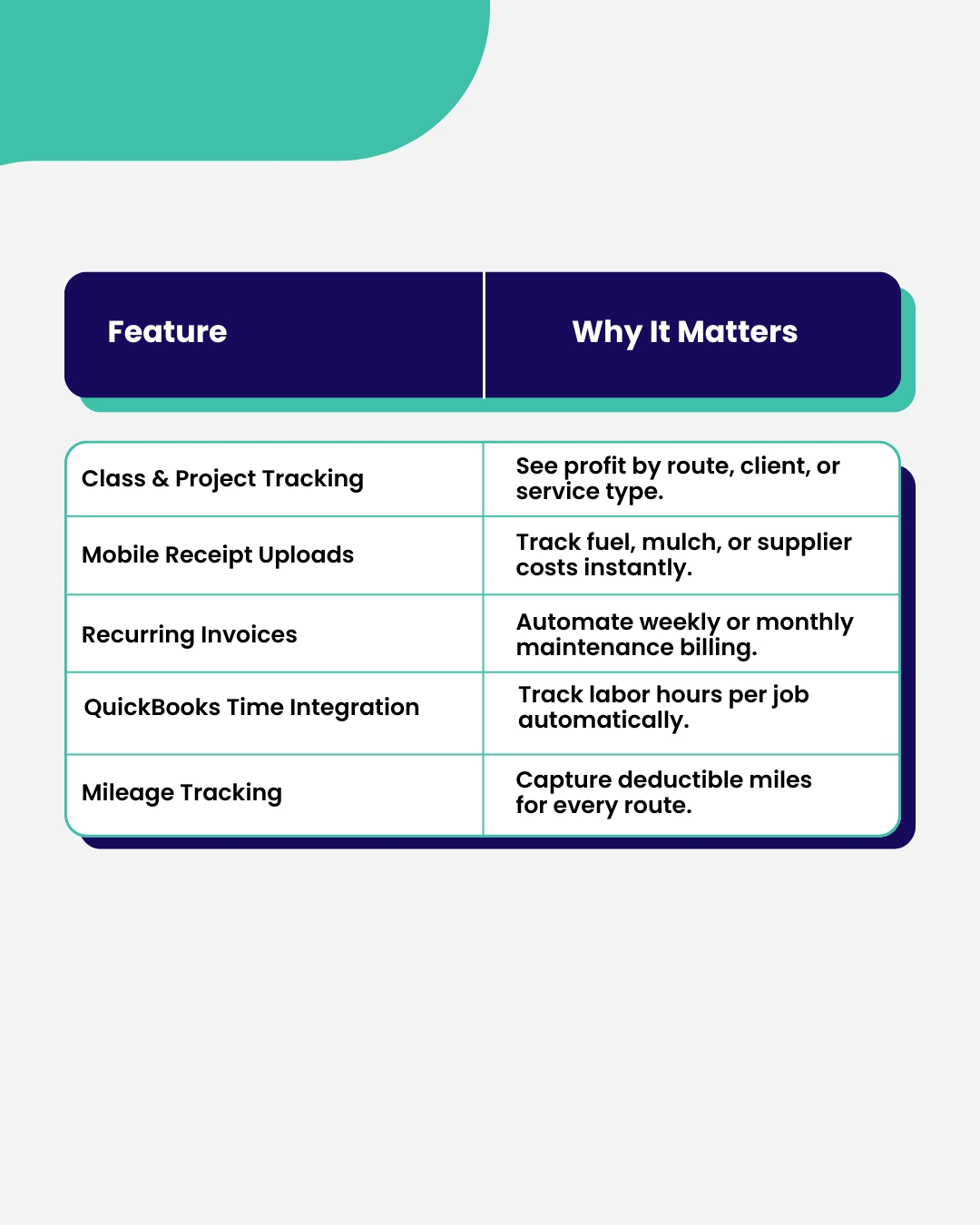
Bookkeeping doesn’t have to be fancy. You just need clear numbers. If you don’t know what you earned, what you spent, and what’s left, it’s impossible to plan the next season.
Get your books in order now so you can focus on running crews, not looking for receipts.
At Little Financial, we help lawn care business owners clean up their QuickBooks, track the right numbers, and stay profitable year-round. If you want clarity before spring hits, reach out to our bookkeeping team and let’s make next season your most profitable yet.
Get your books in order — Schedule a call today to set up QuickBooks for your lawn care business!




.avif)